
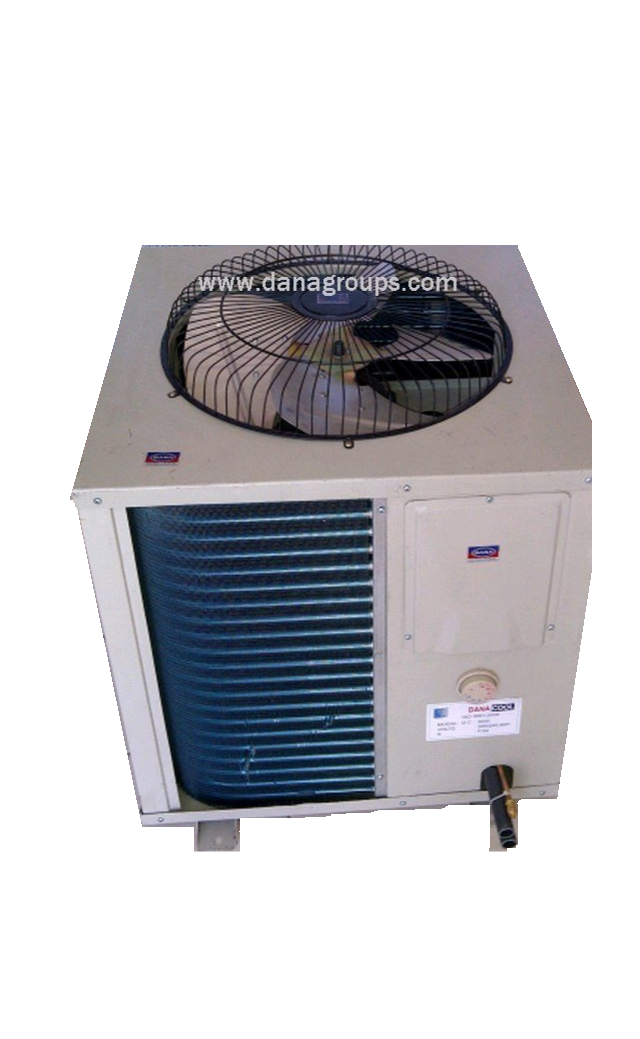
Evaporative Cooler vs Air Conditioner UAE: Which Is Better for Industry?
For UAE construction managers and procurement officers, choosing between an evaporative cooler and a refrigerant air conditioner is a direct cost decision — not a preference. This guide compares both systems on energy consumption, AED running cost, humidity thresholds, and use case fit across industrial applications in the UAE. DANA Group has supplied industrial cooling equipment across the UAE and GCC for 25+ years. This analysis draws on field data from construction sites, labor camps, and warehouse deployments.
How Each System Works
Evaporative Cooler (Desert/Swamp Cooler)
An evaporative cooler draws warm, dry ambient air through water-saturated cellulose or mineral cooling pads. Heat energy transfers from the air into the water, which evaporates. The result is cooler, slightly more humid air discharged into the space. There is no refrigerant, no compressor, and no vapor-compression cycle. Power consumption is limited to a fan motor and a small water pump — typically 1.5–2.2 kW for an industrial unit such as the DANA DEC24000 at 24,000 m³/h airflow.
The physics of evaporative cooling depend entirely on the dryness of incoming air. As relative humidity (RH) rises, the air’s capacity to absorb further water vapor falls, and the cooling effect diminishes. Above 70% RH, an evaporative cooler delivers negligible temperature drop. At 40% RH and 44°C ambient, the DEC24000 can reduce air temperature to approximately 29–34°C.
Refrigerant Air Conditioner (Vapor-Compression Cycle)
A refrigerant AC unit uses a compressor, condenser, expansion valve, and evaporator coil with a refrigerant fluid (R410A or R32) to transfer heat from inside the cooled space to the outside environment. It removes both heat and moisture from indoor air, making it effective in all humidity conditions. The compressor is the primary energy consumer, drawing 8–15 kW for an industrial unit equivalent in cooling output to the DEC24000. This system requires a sealed or near-sealed space to maintain cooled air inside.
UAE Humidity Profile — The Critical Variable
The UAE’s climate varies significantly by season, time of day, and geography. These variations determine when evaporative cooling is viable:
| Condition | Typical RH | Evaporative Cooling Viability |
|---|---|---|
| Inland (Dubai, Sharjah, Abu Dhabi — summer daytime) | 30–55% | Effective — 10–15°C drop achievable |
| Inland (summer morning 06:00–09:00) | 50–65% | Marginal — 6–10°C drop |
| Coastal (Dubai Marina, Abu Dhabi Corniche — summer) | 60–80% | Reduced — 3–7°C drop |
| Coastal (evening / night — July–August) | 75–95% | Not viable — AC required |
| RAK, Fujairah inland — summer daytime | 35–55% | Effective |
| UAE winter (November–March) | 40–65% | Highly effective + low ambient temperature |
For most UAE construction sites operating in daytime hours (07:00–12:30, then 15:00–19:00), relative humidity during the June–September period is typically within the effective range for evaporative cooling — particularly inland sites.
Cost Comparison — AED Running Cost Per Hour
| Cost Metric | Evaporative Cooler (DANA DEC24000) | Refrigerant AC (equivalent output) |
|---|---|---|
| Power draw | 1.5–2.2 kW | 8–15 kW |
| Electricity cost/hr (AED 0.40/kWh) | AED 0.60–0.88 | AED 3.20–6.00 |
| Water consumption/hr | 15–30 L | Nil (condensate only) |
| Water cost/hr (AED 0.01/L approx.) | AED 0.15–0.30 | Nil |
| Total hourly cost | AED 0.75–1.18 | AED 3.20–6.00 |
| Daily cost (10 hrs) | AED 7.50–11.80 | AED 32–60 |
| Monthly cost (25 days) | AED 188–295 | AED 800–1,500 |
| Annual cost (12 months) | AED 2,250–3,540 | AED 9,600–18,000 |
| Capital cost (approx.) | Lower | Higher (+ installation) |
| Refrigerant recharge | Not required | Every 1–3 years |
| Compressor replacement (lifecycle) | Not applicable | Every 7–12 years |
DEWA commercial tariff used as reference (AED 0.40/kWh). Rates vary by emirate (SEWA, FEWA, ADDC). Water cost estimated at AED 0.01/L (municipal supply). Actual figures depend on tariff slab and operating hours.
Use Case Matrix — Which System for Which Application?
| Application | Evaporative Cooler | Refrigerant AC | Verdict |
|---|---|---|---|
| Open construction site rest area | Ideal | Not practical (no sealed space) | Evaporative |
| Covered warehouse / loading bay (open doors) | Ideal | Possible but costly | Evaporative |
| Labor camp dining hall / recreation area | Good (with ventilation) | Works but high utility cost | Evaporative (inland / summer daytime) |
| Site office (enclosed, sealed) | Not suitable | Ideal | AC |
| Factory production floor (semi-open) | Good — spot cooling zones | Expensive at scale | Evaporative for spot; AC for control rooms |
| Outdoor event / temporary structure | Ideal — generator compatible | High power demand for generators | Evaporative |
| Server room / data room | Not suitable — humidity risk | Required | AC only |
| Coastal site (evening, RH above 70%) | Ineffective | Required | AC |
| Retail or commercial office (public-facing) | Not suitable | Required | AC |
When NOT to Use Evaporative Cooling
- Enclosed rooms without exhaust ventilation — humidity accumulates, cooling effect collapses within 20–30 minutes
- Coastal UAE sites during evening hours (July–August) — RH regularly exceeds 75–85%
- Spaces requiring precise temperature control (server rooms, laboratories, cold storage)
- Spaces with heat-sensitive inventory or materials that cannot tolerate increased humidity
- Indoor spaces where occupants remain for extended periods in sealed conditions — humidity discomfort exceeds the thermal benefit
Capital vs Operating Cost — ROI for UAE Construction Sites
For a 3-month summer deployment (June 15 – September 15) on a UAE construction site:
| Scenario | Evaporative (DEC24000) | Refrigerant AC |
|---|---|---|
| Units required for 1,200 m² covered area | 1 unit | 3–4 split units (12,000 BTU each) |
| Installation cost | Nil — portable | AED 2,000–5,000 |
| 3-month electricity cost | AED 563–885 | AED 2,400–4,500 |
| 3-month water cost (evap) | AED 135–270 | Nil |
| Total 3-month operating cost | AED 698–1,155 | AED 2,400–4,500 |
| Relocatable after project | Yes | No (fixed installation) |
For project-based construction operations, the evaporative cooler’s portability is as significant as its energy saving. A fixed AC installation has zero residual value when the site closes; a DEC24000 unit redeploys to the next project.
DANA Group’s Recommendation for UAE Procurement
DANA supplies both evaporative air coolers and traditional HVAC equipment across the UAE and GCC. The procurement decision should be driven by three variables:
- Space type: Open or semi-open = evaporative. Sealed = AC.
- Site humidity profile: Inland daytime = evaporative viable. Coastal evening = AC required.
- Budget structure: Short-term project with relocation = evaporative. Permanent facility = evaluate lifecycle cost of both.
For most UAE construction sites, labor camps, and industrial warehouses operating in daytime hours, the DANA DEC24000 delivers sufficient cooling at a fraction of the energy cost. For enclosed site offices and humidity-sensitive spaces, DANA recommends a dedicated split-unit AC.
Specify your site type, area, and operating hours — DANA’s team will confirm the right cooling solution and provide a quote within 24 hours.
Or email: info@danawatercoolers.com
Related Pages
- DANA DEC24000 Product Page — Full Specifications and Pricing
- Construction Site Cooling Equipment UAE 2026 — Water Coolers & Air Coolers
- Labor Camp Water Coolers — Dubai and Abu Dhabi
Frequently Asked Questions
During inland daytime hours in summer (approximately 07:00–18:00), relative humidity in Dubai, Sharjah, and Abu Dhabi typically ranges from 30–55% — within the effective operating range for evaporative cooling. Cooling performance drops significantly when RH exceeds 65–70%, which occurs primarily in coastal areas during evening and nighttime hours from July through September. For daytime construction site and warehouse applications, evaporative cooling is effective across most UAE emirates.
An industrial evaporative cooler such as the DANA DEC24000 (1.5–2.2 kW) costs approximately AED 188–295 per month to operate at 10 hours/day, 25 days/month, including water consumption. An equivalent refrigerant AC unit drawing 8–15 kW costs AED 800–1,500 per month under the same schedule. The evaporative cooler delivers 70–85% lower monthly operating cost in suitable conditions.
For warehouses with regular door-opening activity during loading and dispatch, an evaporative cooler is the better choice. Frequent door opening makes sealed-space AC inefficient — the cooled air escapes every time a roller door opens. An evaporative cooler operates effectively in semi-open conditions where air exchange is constant. For sealed, temperature-controlled storage, refrigerant AC remains the correct specification.
If an industrial evaporative cooler saves AED 600–1,200 per month in electricity versus equivalent AC capacity, and the unit cost is AED X, payback occurs within the first operating season for most UAE summer deployments. Additionally, the evaporative unit’s portability means it carries zero decommissioning cost — it redeploys to the next site. Contact DANA for a site-specific ROI calculation.
Yes. Many UAE construction sites use evaporative coolers in open or covered outdoor work areas and rest zones, while site offices and control rooms are served by split-unit AC. DANA supplies both systems and can advise on a hybrid layout that minimises total energy cost while meeting the cooling requirements of different site zones.