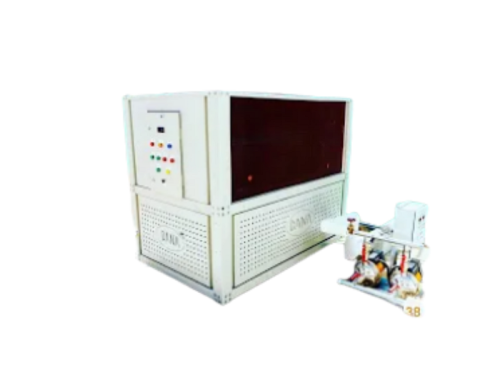
There are many climates with hot weather. Some areas are hot all year round. But that doesn’t mean the inside of the buildings needs to be hot. While the outside temperature can often be more than 37 °C, the inside temperature of the building can be a cool 23 °C. All of this is due to the air cooled water chillers.
Water cooling systems use in medium to large-sized buildings. The industrial cooling plants serve as a centralized cooling system that provides cooling for an entire building or even other buildings by cooling processed water. In order to simplify the access for the maintenance crew of the building, large water chilling systems often provide more energy utilization than smaller individual systems. Check out – Industrial Water Chiller DC 10000.
Basics of the chilled water system
The industrial chilled water systems bring air circulation to the building by using chilled water to trap heat from the grounds of the building. At the edge of the chilled water system, the chiller absorbs heat from the water by use of a refrigeration system.

Installation of Water Chillers on High Roof
The refrigeration cycle of the chilled water system functions by extracting heat from the chilled water in the chiller evaporator. The compressor is what controls its every operation. It also requires the most energy in the chilled water system. Check out – Domestic Water Chiller DC 5000.
In the condenser, the heat energy is transferred to the condenser water or directly to the outside air. The chilled water loop comprises pipes and pumps that transfer the chilled water around the building. A chilled water pump drives cooled water through the chiller and through the chilled water line throughout the building.
Some configurations of chilled water cooling systems are very easy, whereas others are more complicated:
- A standard chilled water cooling system layout may consist of one chiller and one pump.
- The more complex design of the chilled water cooling system consists of multiple chillers, multiple pumps, cooling towers, heat exchangers, and all types of valves to regulate the flow according to the heating rate inside the building.
Chilled Water Cooling Systems
When chilled water is provided by a chiller, the heat which is extracted from the chilled water must be removed outside the house. The chiller device is a heat transfer facilitator between the inside of the building and the outside of the building.
There are two major types of chilled water cooling systems: air-cooled chillers and water-cooled chillers.
Air Cooled Chiller
Industrial air-cooled chillers are quite often installed outside the building and remove heat from the chilled water by absorbing the heat directly from the outdoor temperature.

Air Cooled Chiller
Air-cooled chillers vent heat from the condenser coil. As the hot water flowing through the condenser coil, the outside air passes over the condenser coil and extracts heat from the coolant.
The coolant then flows through the expansion valve, where it cools quickly and passes through the evaporator, in which it cools the chilled water. This process repeats over again.
Water Cooled Chiller
Industrial water-cooled chillers are mostly installed inside the building. They work in exactly the same way as air-cooled chillers. The difference is that they extract heat from the chilled water by transmitting the heat to a separate, single water line as the condenser water line.
The condenser water goes through the chiller and heats up. The condenser water gets back to the cooling tower. The cooling tower is generally placed outside the building. It absorbs heat out of the condenser water by evaporating plenty of the condenser water.
After some of the condenser water evaporates, heat is released out of condenser water, and the cold condenser water continues to flow to the chiller. This process repeats over again.

Water Chiller
Water-cooled chillers are really energy-efficient and reliable. Although because of their complexity and several key aspects, they are also more costly to set up and maintain. For such cause, you typically only found them in large buildings. It is because the energy savings are greater than the expense of implementing and managing the system.
Even so, water-cooled chillers are now also beginning to appear in small buildings. The latest developments were possible for chillers to install and manage in buildings that would not have one.
Applications across Huge Number of Industries
Our chillers are widely used to cooling processed water in many industries such as –
- Paper industry for (Manufacturing, Printing, BOPP /PET Plastic Film, Labels, Card Board,).
- Air-Conditioning (Civil, Industrial, Process, and Domestic).
- Laser (Welding, Profiling, Cutting, Optics, Medical, Marketing, Aesthetics).
- Mechanical (Grinding, Polishing, Profiling, Cutting, Water jet cutting machines, Rolling).
- Food (Chocolate, Beverages, Confectionery, Bakeries, Storage).
- Plastics (Injection, thermoforming, Extrusion, Film Extrusion, Blow Molding, PET/PC Molding).
- Medical Machinery (XRAY, CT SCAN, MRI machines).
- Chemical (Paints, Oil & Gas, Solvents, Petrochemical, and Temperature Control).
- Steel Working Machinery (Waterjet, CNC, Hydraulic Power packs).
- Other (Gold & Silver, Pharmaceutical, Wood, Ceramics, Textile).
Optimizing Chiller Plant
The chilling plant is also a major part of the energy need for buildings. If you realize that chillers are among one of the largest energy consumers in a building, their efficiency can have a significant effect on capital costs. For all this reason, the performance of the chiller plant carefully monitors for possible improvement.
Optimization of a chiller plant is a challenging task that requires collecting data and making estimations. These estimations help to effectively operate the chiller plant.
For example, during cool nighttime, it would be more viable to raise the chilled water supply temperature of the chiller. Increasing the temperature setpoints of the chilled water supply enable the chiller to perform easier.
Conclusion
Chilled water systems use for the cooling of medium-sized and large-sized buildings. Although there might be a lot of initial costs for a chiller plant, higher energy performance and reduced maintenance costs typically match for it.
A chiller is essentially a heat transfer facilitator between both the inside and the outside of the building, and the chilling water system may have so many different implementations. Water-cooled chillers and air-cooled chillers are the most widely popular chillers.
About Us
DANA water heaters & coolers factory LLC (www.danawatercoolers.com) established in 2001 is an ISO 9001:2015 certified company. Our company manufactures our products and we are stainless steel water cooler supplier in UAE. And we present our gratitude to you with immense pride and honor to associate ourselves among the leading producers of water chillers with other cooling and refrigerant solutions, being able to provide our services in almost all Gulf countries and also some African countries including Oman, Bahrain, Kuwait, Saudi Arabia, Jordan and some other GCC nations alongside Arab countries.
We at DANA group have always kept in mind, restrictions, and problems our consumers face and tend to work with utter determination so that we can eliminate these boundaries and bring the best to you at affordable prices. We bring about the product for use in a variety of sectors. Our domestic overhead coolers are an example of our dedication to bringing the best for the complete spectrum of consumers.
Feel free to contact me in case of any inquiry. Listed below are the mediums through which you can reach us out!
For Within UAE we have our Expert Mobile Team, which handles all the installations and after-sales support. We provide service across Dubai, Ajman, Sharjah, and Abu Dhabi, Al Ain, RAK, UAQ, and surrounding areas.
For Outside UAE, we are having our agent network, or we also able to send our technicians overseas to handle complete turnkey installations.
Tel – 0097142217273
Email – info@danagroups.com / info@danawatercoolers.com